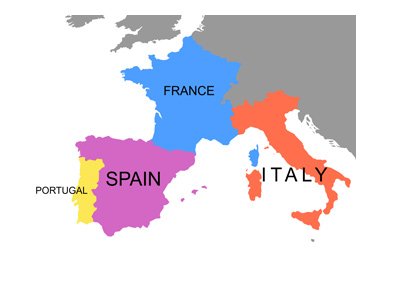
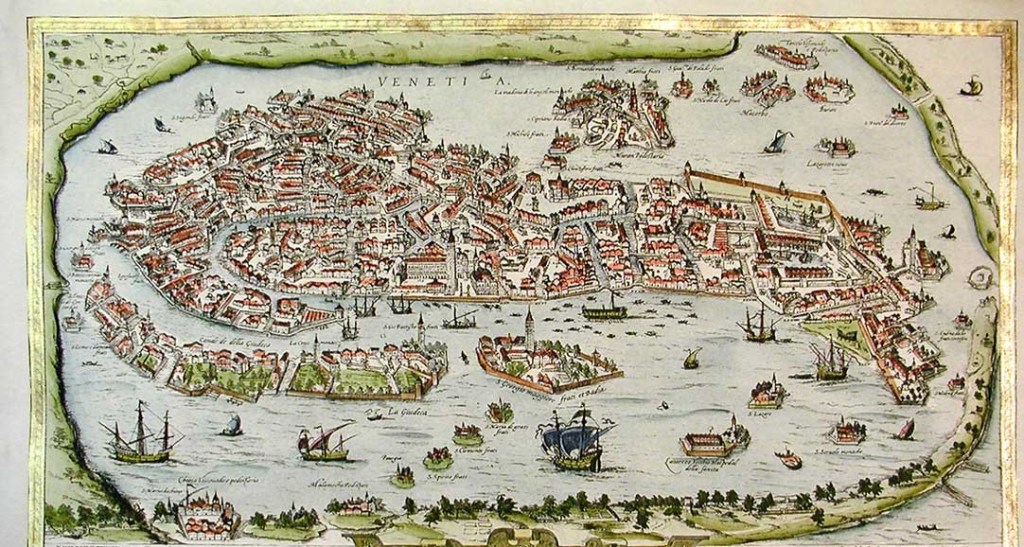
About 1,600 years ago, angry Germans (Goths and Vandals) culminated their invasion of southern Europe by finally sacking the remains of the Roman Empire. People living on the northeast coast of the Italian peninsula started to freak out because they worried those same conquerors might head their way. So, seeing a cluster of marshy islands just off the shore, they devised a plan to establish an encampment there.
Building on a swamp is kind of a challenge, so they brought with them boatloads of long tree trunks (think telephone poles) and pounded them into the swampy ground to create foundations for their buildings. Yada, yada, yada, their plan was a success, the barbarians never got them, and 1,000 years later that swampland was Venice – a world power, the center of trade between the east and the west, and one of the richest, most amazing cities on the planet.
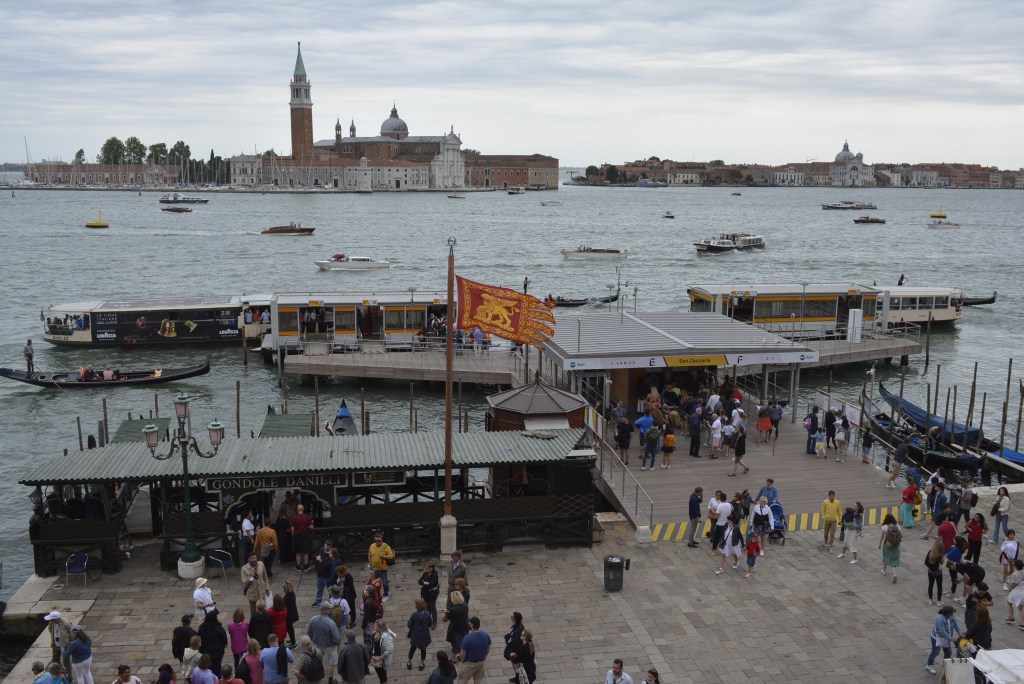
Today, millions of those calcified telephone poles remain – holding up a city of magnificent architecture, with a dwindling population of locals but once again swarming with hoards of post-Covid tourists. Gondolas and boats of all sorts crisscross the Grand Lagoon, and the air buzzes with the excited conversations of 1,000’s of visitors sharing their enthusiasm for this once great, but still proud city that feels like the center of the world.
Following an afternoon of aimless wandering on Saturday, we sluggishly stumbled into the restaurant Do Forni for dinner. The wine list included over 10 pages of Tuscan reds, and our waiter selected a pricey 1990 vintage he claimed was “our last bottle.” A quick sip indicated a smooth and pleasing taste, but with some sediment in the bottle we agreed decanting was in order.
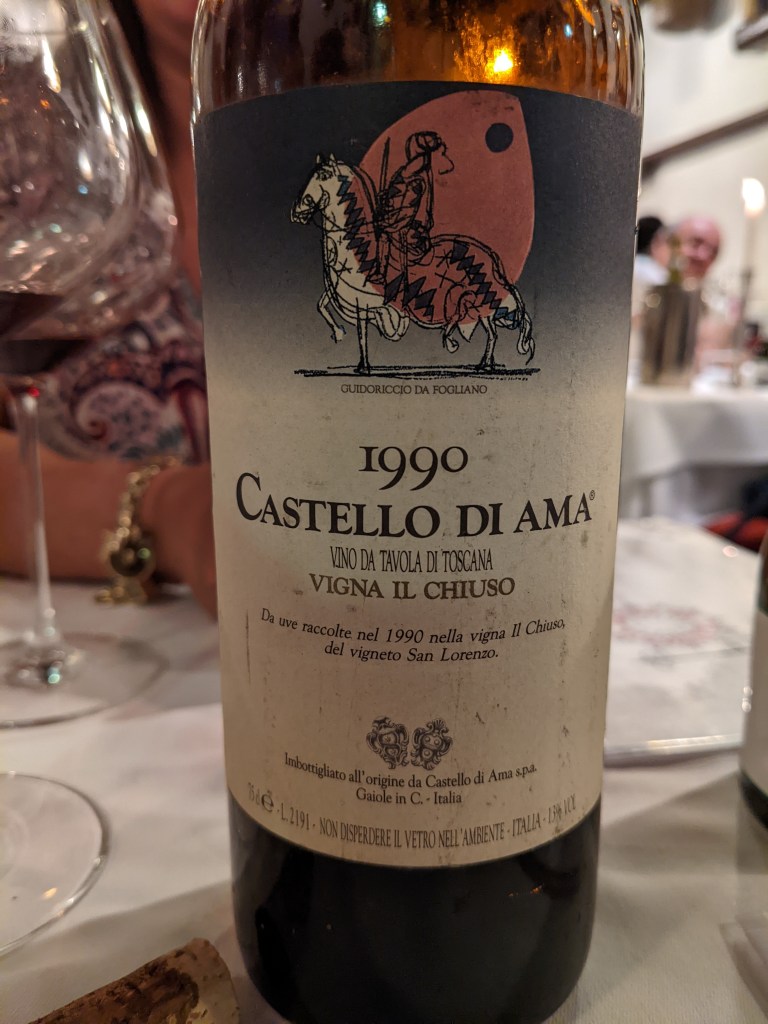
Eagle-eyed Shawna noted the waiter began the decanting process by first pouring himself a glass (or as I later called it, “his tip”), and once decanted, we enthusiastically enjoyed the rest while inhaling crisp salads and two amazing pasta dishes. Wanting to justify the bottle’s price tag, I sent the picture of the label to wine enthusiast, Jim Wagner, who informed me the bottle’s value was almost solely due to its age. Apparently, we paid big Euros for the equivalent of a 32-year old bottle of Barefoot Merlot.
Despite this, Do Forni was a worthy experience with food any taste bud would lust after. Our visit was augmented by the multilingual Russian mother and daughter whose table was roughly 5 inches to our left and with whom I enjoyed a pleasant, but broken, conversation in French. Our conversation was punctuated by their regret for their leader’s invasion of Ukraine, providing me further insight into the experiences and thoughts of foreign people we might otherwise judge hastily.
On Day 2, we had a guided tour of the Doge’s Palace and of St Mark’s Cathedral, two of the city’s main architectural highlights.
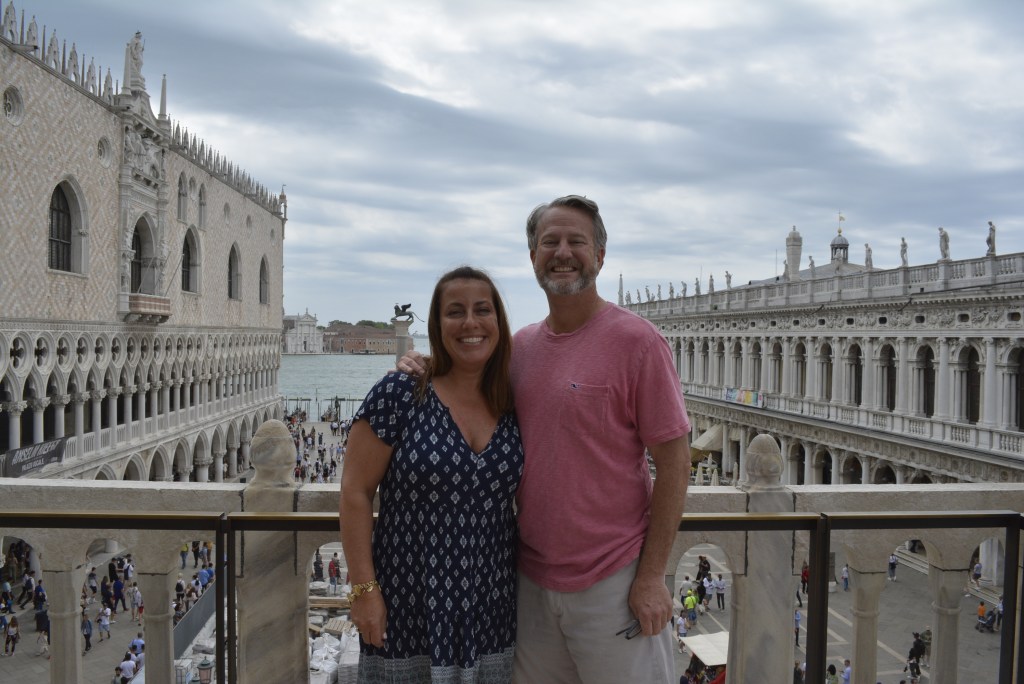
Who was the Doge? He (and yes, it was always a he) was largely a figurehead and a representative for the government. His “palace” was actually Venice’s government building – a combination of the White House, the Supreme Court and the Congress all under one roof. The Doge’s “suite” itself was only about 1,000 sf in size.
The palace was built to impress – particularly visiting ambassadors and heads of state. From my perspective, it sure met it’s objective.
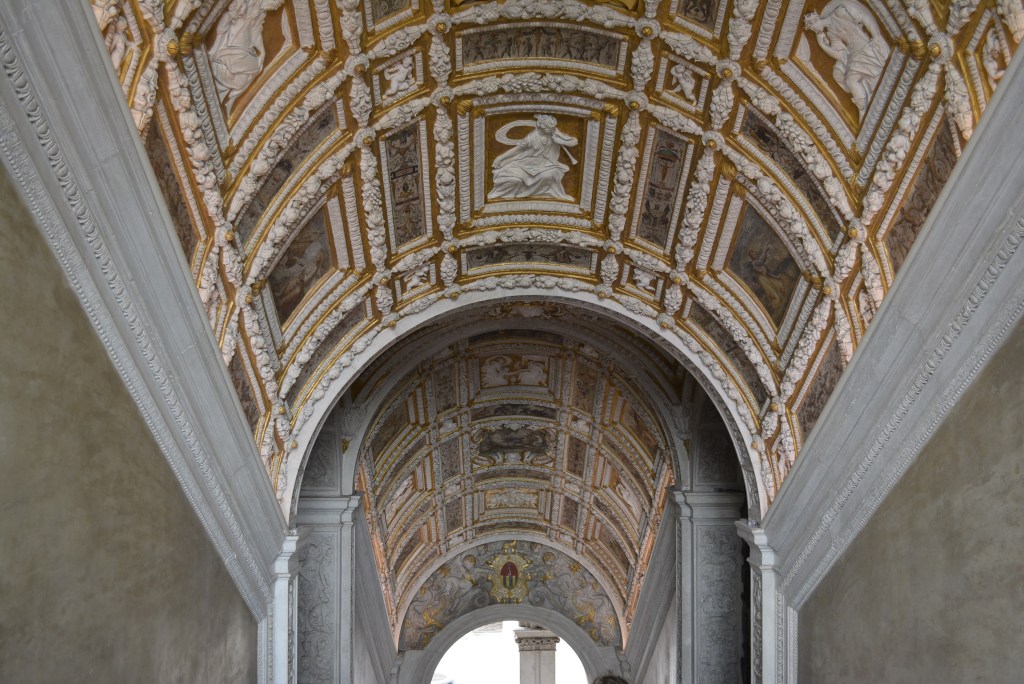
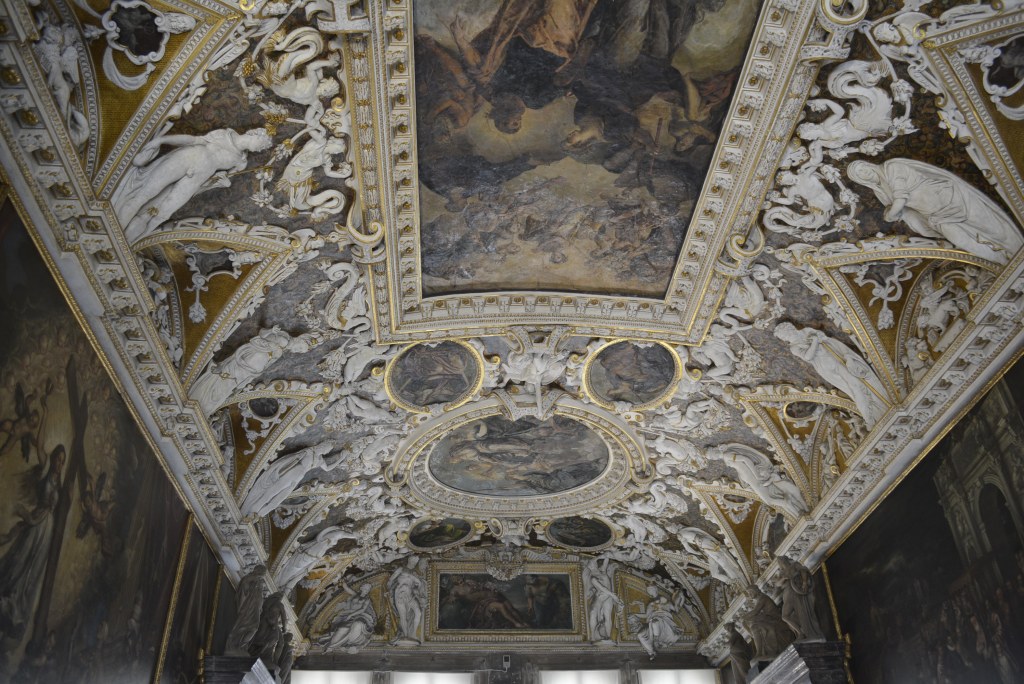
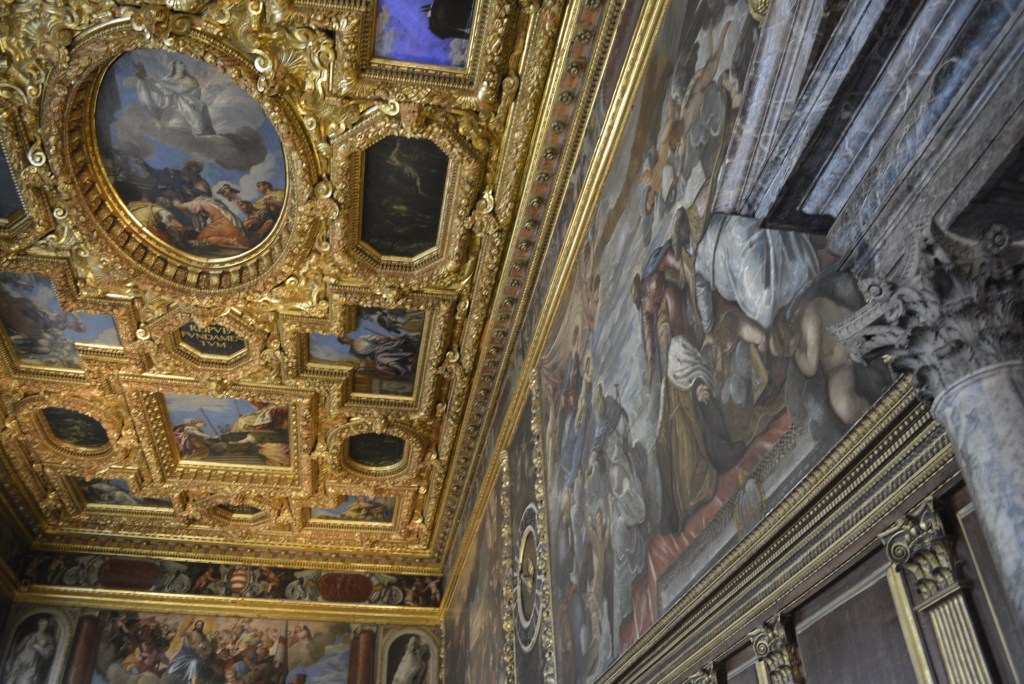
In its role as a court, those accused of a crime were detained in cells in the Palace while they awaited trial. If convicted, they were taken immediately to prison, which conveniently had been built just across a canal from the Palace. The Venetians even built an elaborate crosswalk from the palace to the prison.
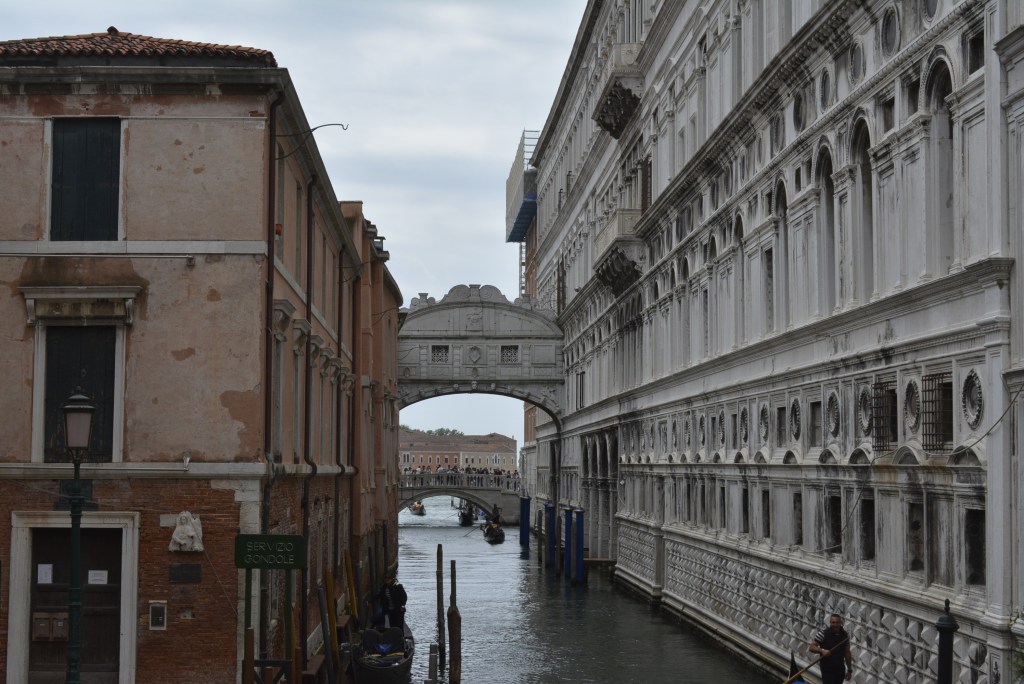
Over time, this walkway earned the nickname “Bridge of Sighs,” a pretty poignant description.
While touring the palace, I learned that while highly influenced by the laws of ancient Rome and of England, the Founders of the United States borrowed much from the Venetian constitution when creating our own. Both the Venetians and our Founders recognized the human tendency for greed and despotism in government and structured their constitutions with many checks and balances. If only our country had also followed Venice’s lead when it came to imposing term limits. Key government leaders in Venice served just 1 year terms and had to wait a year after serving before they could run for re-election. This might explain why Venice lasted nearly 1,100 years as an independent country! How much better would our government be if our key leaders weren’t able to stay in power for 20, 30 or 40 years? Right?
Moving on to St. Mark’s Cathedral, like so many other cathedrals and basilicas around the world, it is spectacular. But two cool stories about it.
First, St. Mark is the Mark who wrote the 2nd book of the new testament (you know, Matthew, MARK, Luke, John). He is revered by Venetians, and his symbol – the lion – is all over the city. Mark was murdered by pagans in 68 AD and was buried in Egypt. In 828 AD a team of Venetians journeyed to Egypt, stole St. Mark’s bones and brought them to Venice where they were buried under the massive alter at St. Mark’s cathedral.
Or were they?
Rumor has it that the bones brought back to Venice were actually those of Alexander the Great. Two intriguing clues might support this theory:
- Why is there a large carving of Alexander on the outside wall of St. Mark’s Cathedral?
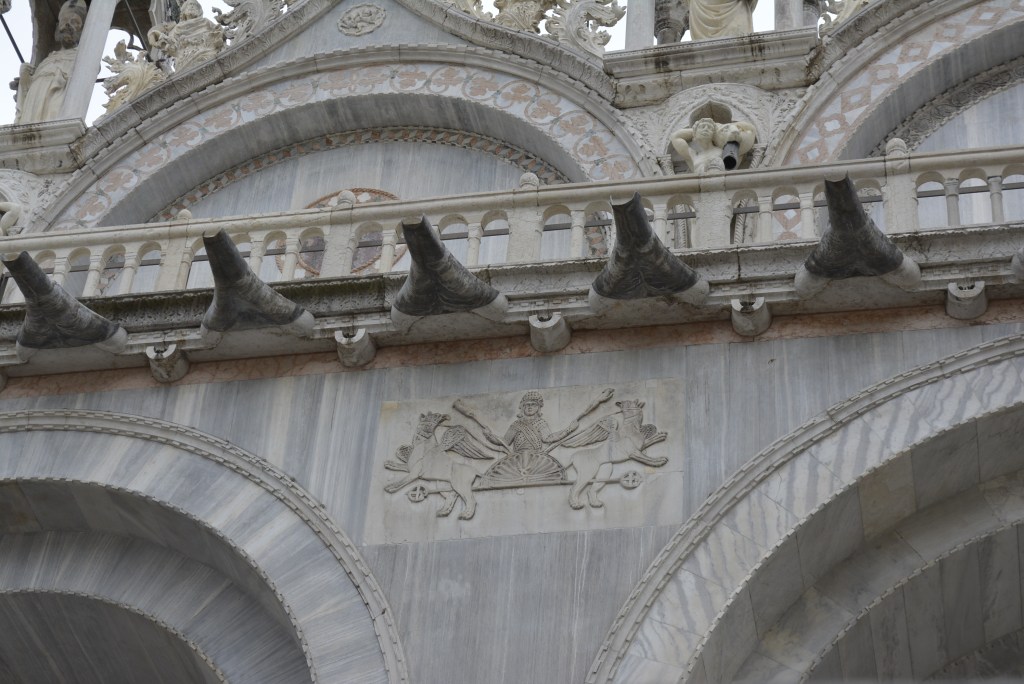
Alexander was never in Venice, having died long before the first permanent settlement was built, and the cathedral was built about 200 years after the bones were brought to Venice.
2. In the mid 1800’s, the tomb containing St. Mark’s bones was opened. There amongst the bones was a token containing the symbol of Alexander the Great.
To date, the Catholic church has denied multiple requests to do a DNA test on the bones. Just sayin’ …
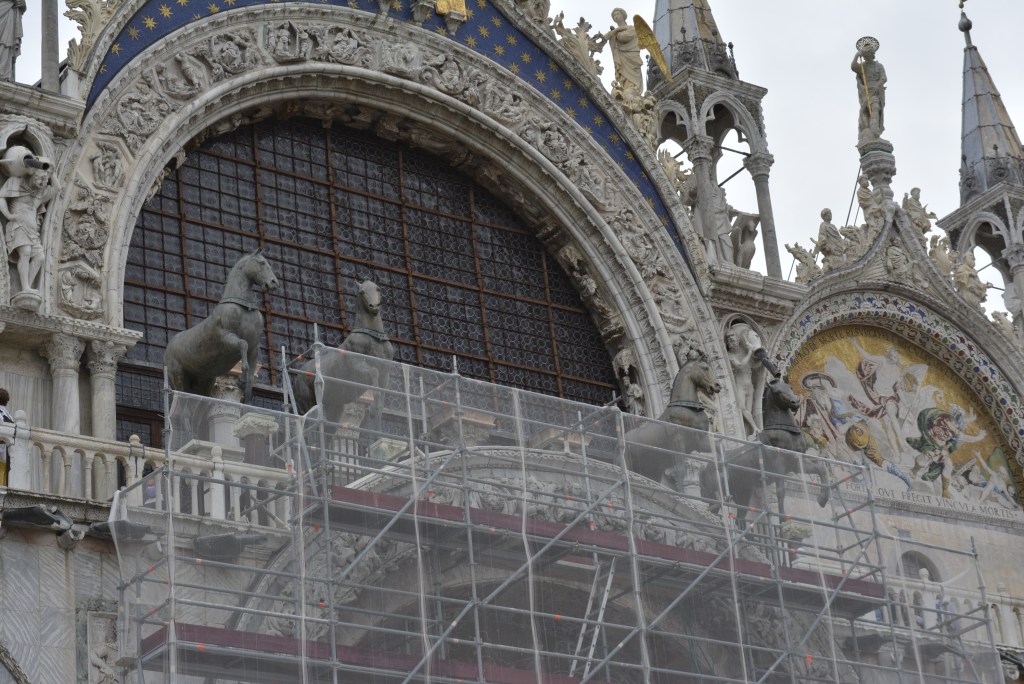
The second thing about St. Mark’s cathedral I found riveting is the four stately bronze horses mounted on the balcony above the front door.
BORING HISTORY ALERT!!
You might have a sketchy memory of something known as “The Crusades.” There were eight of them (many led by the French and supported by Venice), and they largely involved Christians trying to retake Jerusalem from the Muslims. After failing the first three times, a 4th crusade was launched in 1202. The crusaders came from France to Venice to launch their assault, but were having trouble raising funds. So, they changed course.
Instead of heading to the Middle East to conquer Muslims, they instead headed to Constantinople (modern day Istanbul) to attack fellow Christians. Why? Well one theory is the Christians in Constantinople were Orthodox, while Venice was Roman Catholic. If true, this was yet another incidence of people using religion as a vehicle to do dreadful things. The real reason was, of course, money. The French reached a booty-sharing agreement with the Venetians to split the spoils from ransacking the town.
Some of the items pilfered included Jesus’ crown of thorns, a nail from his cross and a piece of the cross itself. But the booty also included four majestic bronze horses. These were likely built by the Greeks 200 years before Christ, and when they arrived in Venice they were promptly installed on the balcony of St. Mark’s church.
In 1982 replicas were built and the originals were brought inside the church where you can now see them up close. They are truly noble beasts!
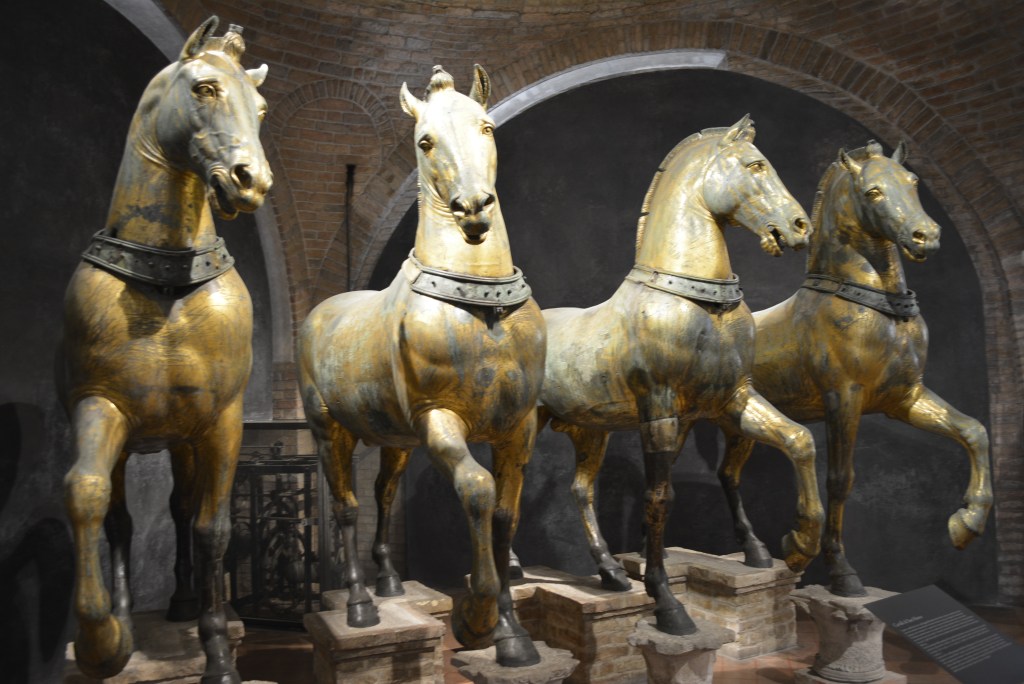
Ancient Greeks crafted wax models of the horses, then used those models to create clay molds, and then poured molten bronze into the molds. For two Millennia they’ve stood in the hippodrome of Constantinople and then on the balcony of St. Marks, seen and admired by countless millions over 22 centuries – yet here they were an arms-length away from me!
These brass beauties are stunning. When you look closely, you can see wrinkles in the horses’ skin and veins bulging from their legs and faces. I never cease to be awe-struck by how advanced ancient cultures were – not only in their philosophies, but also their technologies.
History can be boring. But when you stand 3 feet away it can comes to life!
Great post! The restaurant in Positano looks wonderful! Although the taxi cost sounds very outrageous!
Thanks for the Blogs!! Enjoyed every one of them….felt like I ate and drank with you along the way! Cant…
That’s a cool building.
Tim, fun fact I studied abroad in Aix-en-Provence and I spy, in one of your photos, the spot I ate…
In case you’re wondering, I am reading (and enjoying) your blogs. I just can’t come up with anything more clever…


 Italian French Spanish Morrocan Portuguese Adventure
Leave a reply to Ellie Halls Cancel reply